

Last updated on August 6th, 2026 at 09:53 am
Kenwood walkie talkies come in two lines: the pocket-sized PKT-23 for casual use (around $30, no license required) and the ProTalk business series ($80–$200, FCC Part 90 license needed for VHF/UHF models). For work crews, the ProTalk TK-3400U16P gives the best indoor range and a battery that covers a 12-hour shift. The PKT-23 handles family outings and small retail teams without any paperwork.
I’ve used Kenwood radios on construction sites and security details for years. They’re not the flashiest brand, but they’re built by the same company that makes professional police scanners and aviation radios. That pedigree shows up in the ProTalk line—solid hardware that takes a beating without complaining.
The tricky part with Kenwood is figuring out which radio actually fits your situation. The PKT-23 and the TK-3400U16P look similar on paper but serve completely different users. Get the wrong one and you’re either paying for a license you don’t need or buying a consumer toy that won’t survive a job site. This guide breaks it down clearly. No spec-sheet padding, just what you need to know to pick the right radio and what to expect out of it.
Quick look — top Kenwood walkie talkies
ProTalk TK-2400V16P
Best VHF option — longer outdoor range, Part 90 license required
ProTalk TK-3400U16P
Best professional — UHF for warehouses and multi-story buildings
What to look for in a Kenwood walkie talkie
FRS vs business band — this decides everything
FRS (FRS walkie talkie frequencies) radios need no license and cap power at 2W on shared channels. They work fine for retail floors, small event teams, or family use. Business band VHF/UHF radios operate on licensed frequencies with cleaner channels and better range. If you’re running a crew on a job site or warehouse, the Part 90 license costs $115 for 5 years — well worth it for the performance gain.
VHF vs UHF for your environment
VHF (136–174 MHz) travels farther outdoors — construction sites, outdoor events, farms. UHF (400–470 MHz) penetrates concrete and steel better — warehouses, hotels, multi-floor buildings. If you’re ever inside a structure with thick walls, UHF wins every time. For outdoor-only work, VHF gives you the edge on raw distance. Read more about walkie talkie frequencies and bands to understand which fits your terrain.
Battery type and shift coverage
Consumer radios like the PKT-23 run on standard AAA batteries — good for occasional use, expensive if your team is on radio all day. ProTalk models come with rechargeable NiMH packs and desktop chargers. A fully charged ProTalk battery covers 8–12 hours of typical business use. Buy a spare pack for shift workers so one charges while the other’s in the radio.
IP rating — what IP54 actually means
All the radios here carry IP54 protection. That means dust-resistant and splash-proof — light rain, a spilled drink, sweaty hands. It does not mean submersible. If your team works in wet environments or near water, look at waterproof two-way radios rated IP67 or better instead. IP54 is fine for construction and warehouses; it’s not for marine work.
Channel count and programming
The PKT-23 and TK-3501 come pre-programmed with 22 FRS channels — ready out of the box. ProTalk VHF/UHF models have 16 programmable channels set to licensed business frequencies. You’ll need Kenwood’s KPG-49D software or a dealer to program them if you want custom channels. Plan for that setup time before you put them in the field.
Real-world range expectations
Kenwood’s box claims mean nothing. At 0.5W (PKT-23), walkie talkie range is 0.3–0.6 miles in a city. The ProTalk models at 2W get you 0.5–1.5 miles in urban areas and 2–5 miles in open fields. No handheld radio breaks the laws of physics. Concrete, steel beams, and elevation changes all cut range. If you need reliable coverage across a large outdoor site, consider heavy duty walkie talkies with higher output or repeater support.
Quick comparison — Kenwood walkie talkie lineup
| Model | Type | Power | License | IP Rating | Battery | Score |
|---|---|---|---|---|---|---|
| PKT-23 | FRS consumer | 0.5W | None | IP54 | 2x AAA | 4.5/5 |
| TK-3501 | FRS business | 2W | None | IP54 | NiMH rechargeable | 4.2/5 |
| TK-2400V16P | VHF business | 2W | FCC Part 90 | IP54 | NiMH rechargeable | 4.3/5 |
| TK-3400U16P | UHF professional | 2W | FCC Part 90 | IP54/55 | NiMH rechargeable | 4.4/5 |
Kenwood PKT-23 — Best Consumer Kenwood Walkie Talkie
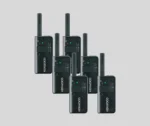
The PKT-23 is absurdly small. I mean that in a good way. It fits flat in a shirt pocket — 2.7 inches tall, 1.9 inches wide, barely half an inch thick. Drop it in a retail uniform pocket and your staff won’t even notice it’s there.
Runs on two AAA batteries and gets a solid 8–10 hours of mixed use. At 0.5W output, real range in a retail store or small venue is about 200–400 feet through walls. In a clear parking lot you might hit a quarter mile. Don’t expect more than that — FRS at 0.5W is what it is.
22 channels, 121 CTCSS privacy codes, push-to-talk, Roger beep. No VOX on the PKT-23, which is a miss if you want hands-free. And because it’s an FRS radio, it shares frequencies with every other FRS device in range — privacy codes help but don’t encrypt. IP54 means it handles a spilled coffee or rain dash but don’t submerge it.
What makes it the Editor’s Choice isn’t raw specs — it’s the zero-friction setup. Take it out of the box, put in batteries, pick a channel, talk. No license, no programming software, no learning curve. For a restaurant, boutique, small warehouse section, or family hiking trip, that’s exactly what you need.
Pros
- Smallest Kenwood radio — true shirt-pocket size
- No license required
- Ready out of the box — zero setup
- 121 privacy codes to cut interference
- Affordable — around $25–$35
Cons
- 0.5W limits real-world range to under half a mile
- No VOX (no hands-free option)
- AAA batteries add ongoing cost for heavy users
- No rechargeable pack available
- Not for job sites — range and durability ceiling is low
Verdict: If you need a simple, lightweight communication tool for a small team, event, or family outing — the PKT-23 is hard to beat at this price. Don’t buy it expecting job-site performance. That’s not what it’s built for.
Kenwood ProTalk TK-3501 — FRS Business Radio, No License
The TK-3501 is the step up from the PKT-23 without crossing into the licensed business band. You still get 22 FRS channels, no FCC paperwork, and pre-programmed operation out of the box. But now you have 2W output, a rechargeable NiMH battery, and a desktop charging cradle — the kind of setup that works in a business environment.
Real range bumps to around 0.5–1 mile clear field, 300–600 feet through building walls. That extra wattage makes a real difference when you’re coordinating across a large retail floor or warehouse section. VOX is available on this model — useful for staff who need hands free. Battery life runs 8–12 hours per charge depending on use.
The build is noticeably sturdier than the PKT-23 — ProTalk plastic, rubber-reinforced, IP54. The larger footprint also means better antenna performance. You’ll feel the difference if you’ve used consumer radios before.
Where it falls short: at $80–$100 per unit, buying a team set isn’t cheap. And you’re still on shared FRS frequencies — you’ll share airspace with neighboring businesses on the same channel. Privacy codes reduce crosstalk but don’t eliminate it. If channel congestion is a concern, that’s when you step up to the licensed VHF/UHF models.
Pros
- 2W output — meaningfully better range than PKT-23
- Rechargeable NiMH battery + desktop charger included
- VOX for hands-free operation
- No FCC license required
- Business-grade build quality
Cons
- Higher cost than consumer alternatives
- Shared FRS frequencies can cause channel congestion
- Still limited to FRS power caps (2W max)
- No encryption or true channel privacy
Verdict: The right pick for a small business team that wants step-up radio quality without dealing with FCC licensing. Retail, hospitality, small events — the TK-3501 handles them cleanly.
Kenwood ProTalk TK-2400V16P — VHF Business Radio
Very Good
5W FCC-certified VHF · IP54 · $250
Why this score: Range: 5W FCC-certified VHF — normalized against 5.0W category max. Audio (No VOX — PTT only; audio quality not differentiatable from spec data alone) limits the overall score.
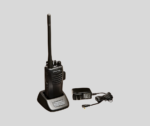
Here’s where Kenwood’s commercial DNA shows up properly. The TK-2400V16P operates on VHF business band frequencies (136–174 MHz) — the same spectrum that professional communications teams have used for decades. But you need a Part 90 FCC license to use it legally. That’s not optional.
The VHF advantage is outdoor range. At 2W on a licensed VHF frequency, expect 2–5 miles across open terrain. That works for construction sites spanning multiple acres, outdoor event grounds, or agricultural operations. VHF signals travel farther over open ground than UHF — the physics of longer wavelengths working in your favor.
16 channels, all programmable via Kenwood software. You’ll program them to your licensed business frequencies before deployment. The setup takes 30–60 minutes with KPG-49D software — straightforward if you’ve done it before, slightly confusing the first time. IP54, NiMH rechargeable battery, desk charger included. Compatible with most standard Kenwood ProTalk accessories like earpieces and speaker-mics.
The weakness: VHF doesn’t penetrate heavy structural materials well. If your crew moves between outdoor areas and dense building interiors, you’ll notice dead spots inside. That’s where UHF wins. For site work that stays outdoors, this is exactly the right tool. Compare this with how Motorola’s business radios handle the same VHF/UHF decision.
Pros
- VHF range advantage for outdoor work — 2–5 miles realistically
- Licensed frequencies — no shared channel congestion
- 16 programmable channels for team coordination
- Rechargeable NiMH + multi-unit chargers available
- Full ProTalk accessory ecosystem
Cons
- FCC Part 90 license required ($115/5 years)
- Needs programming software for channel setup
- VHF penetrates buildings and walls poorly
- Higher per-unit cost than FRS alternatives
Verdict: The outdoor work site radio. Construction crews, ground crews at outdoor events, farm operations — VHF range covers ground that FRS radios can’t. Just get the license sorted before you put these in the field.
Kenwood ProTalk TK-3400U16P — UHF Business Radio for Indoors
Good
5W FCC-certified UHF · IP54 · $110
Why this score: Range: 5W FCC-certified UHF — normalized against 5.0W category max. Battery (1100mAh — 73% of category average (1500mAh)) limits the overall score.
UHF is the right frequency band for any operation happening inside a building with concrete floors, steel beams, or thick walls. The TK-3400U16P operates in the 450–470 MHz UHF range and handles building penetration that VHF radios just can’t manage. Hotels, warehouses, multi-story retail, hospitals — UHF keeps signal consistent floor-to-floor in a way that VHF won’t.
Same 2W output as the VHF version, but the shorter wavelength cuts through structural materials. In a five-floor hotel, expect floor-to-floor coverage without dead spots. That’s not a guarantee at the top and bottom of the building, but it’s significantly better than alternatives at this price point. Battery life is 10–14 hours on a full charge — enough for two overlapping shifts on one battery pack if usage is typical.
Build quality is the best in the ProTalk line here. IP54/55 rated, with a reinforced housing that handles drops better than the consumer models. Side-tone feedback, loud front-facing speaker (91 dB — useful in a noisy warehouse), and 16 programmable UHF channels. Same Kenwood accessory ecosystem as the TK-2400V16P — earpieces, speaker-mics, and multi-unit chargers all compatible.
The learning curve is real. This isn’t a radio you hand to new staff without orientation. Channel selectors, squelch settings, VOX sensitivity — all configurable, all requiring setup. And the Part 90 license is non-negotiable. But for operations that need reliable radio across a complex building environment, this is the Kenwood to buy. This is the kind of professional radio discussed in our construction walkie talkie guide — reliable comms for complex multi-area operations.
Pros
- UHF penetrates concrete and steel far better than VHF
- 10–14 hour battery — covers double shifts
- IP54/55 — best durability in this lineup
- 91 dB speaker audible in loud environments
- VOX, scan, monitor, all programmable
Cons
- FCC Part 90 license required
- Steeper learning curve for non-technical users
- Higher per-unit price
- Needs programming before deployment
Verdict: The TK-3400U16P is what you buy when you need radio to work inside a building without excuses. Hotels, hospitals, large retail, warehouses — UHF + Kenwood build quality makes this a long-term investment, not a disposable purchase.
ProTalk vs NEXEDGE — What Kenwood’s Product Lines Actually Mean
Nobody explains this clearly, so here it is. Kenwood makes two completely separate commercial radio lines and they get confused constantly.
ProTalk is analog. It runs on FRS channels (no license) or licensed VHF/UHF business band frequencies (Part 90 license required). The radios on this page are all ProTalk. Analog means simple, cheap to license, compatible with any analog business radio from any brand on the same frequency.
NEXEDGE is Kenwood’s digital radio system. It uses a proprietary protocol called NXDN (Narrowband eXtended Data and voice). NEXEDGE radios are what you’d see at a police department, municipality, or large industrial complex. They require Part 90 licensing just like the ProTalk VHF/UHF models, but they’re in a completely different price tier — typically $300–$800+ per radio versus $80–$200 for ProTalk.
The benefit of NEXEDGE over ProTalk isn’t just range. It’s encryption, cleaner audio in noisy environments, and the ability to carry both voice and data over the same channel. For most businesses, ProTalk is the right answer. NEXEDGE is for organizations with stricter communication security requirements or large-scale deployments where digital infrastructure justifies the cost.
ProTalk vs NEXEDGE at a glance
| Feature | ProTalk (analog) | NEXEDGE (digital) |
|---|---|---|
| Technology | Analog FM | Digital NXDN |
| Price per radio | $30–$200 | $300–$800+ |
| License required | None (FRS) or Part 90 (VHF/UHF) | FCC Part 90 |
| Encryption | No (privacy codes only) | Yes (built-in) |
| Interoperability | Any analog radio, same frequency | NEXEDGE only (proprietary) |
| Typical users | Small–medium business | Public safety, enterprise |
| Data over radio | No | Yes |
How to choose the right Kenwood walkie talkie for your situation
You run a small retail shop or restaurant
The PKT-23 is your answer. No license hassle, nothing to program, and your staff can figure it out in 30 seconds. Buy two or three units, pick a channel, done. Range across a single-story building or small lot is plenty at this scale. If you’re comparing Kenwood to alternatives at this price point, also look at the Retevis lineup — comparable specs, occasionally better pricing.
You manage a mid-size team that works indoors
Step up to the TK-3501. The rechargeable battery alone justifies the upgrade for teams using radios across a full shift. No license still, but you get 2W, VOX, and a more professional build. Hospitality, retail management, event staff — this tier fits cleanly.
Your crew works on large outdoor construction sites
The TK-2400V16P VHF model. VHF range across open terrain beats UHF. Get the Part 90 license (one application covers your whole frequency block) and program channels with your contractor’s dedicated frequency. Your foremen need coverage across 3–5 acres? VHF handles it. See our full guide to construction walkie talkies for site-specific recommendations.
You coordinate across a multi-floor building
UHF every time. The TK-3400U16P. Hotels, warehouses, healthcare facilities, large retail — any environment with structural barriers between floors needs UHF frequency penetration. VHF dies on stairwells and elevator shafts. UHF doesn’t. And if your work involves moisture, chemical splash, or rough handling, look at our heavy duty walkie talkie options alongside this one.
You need radios for a one-time event
Rent instead of buy. If it’s a recurring annual event, the TK-3501 pays for itself in two seasons over rental costs. For a single weekend, rentals from a two-way radio dealer make more sense than buying a full set you’ll use once.
Frequently Asked Questions
Do Kenwood walkie talkies require a license?
It depends on the model. The PKT-23 and TK-3501 operate on FRS frequencies and require no license. The ProTalk TK-2400V16P (VHF) and TK-3400U16P (UHF) operate on licensed business band frequencies and require an FCC Part 90 license, which costs $115 for a 5-year term. Operating without a license on licensed frequencies is a federal violation.
What is the real-world range of Kenwood ProTalk radios?
The PKT-23 gets 0.3–0.6 miles in real conditions. The TK-3501 reaches 0.5–1 mile on FRS frequencies. The TK-2400V16P VHF model achieves 2–5 miles across open outdoor terrain. The TK-3400U16P UHF model reaches 1–3 miles outdoors but performs significantly better through building walls and floors than any VHF model. All range claims on product boxes are theoretical maximums under perfect conditions.
What is the difference between ProTalk and NEXEDGE?
ProTalk is Kenwood’s analog business radio line — affordable, no encryption, compatible with any analog radio on the same frequency. NEXEDGE is Kenwood’s digital radio system using the NXDN protocol, designed for public safety and enterprise users. NEXEDGE radios cost $300–$800+ and include built-in encryption and data-over-radio capability. Most businesses need ProTalk. NEXEDGE is for organizations with strict security or large-scale deployment needs.
Can Kenwood ProTalk radios talk to Motorola radios?
Yes, on FRS frequencies — any FRS radio from any brand can communicate with any other FRS radio on the same channel. For licensed VHF/UHF business band, Kenwood and Motorola analog radios can communicate on the same licensed frequency. They won’t communicate across proprietary digital protocols like Motorola’s MOTOTRBO or Kenwood’s NEXEDGE without a cross-band solution.
How long do Kenwood ProTalk batteries last?
ProTalk NiMH rechargeable batteries last 8–14 hours per charge depending on transmit frequency (how often your team talks). Light-use teams get toward the upper end; heavy-traffic operations land in the 8–10 hour range. A full charge from empty takes 2–3 hours. For continuous operations, buy a spare battery and rotate them through the desktop charger.
Which is better for indoors — VHF or UHF Kenwood radios?
UHF without question. UHF frequencies (400–470 MHz) penetrate concrete, steel, and other structural materials significantly better than VHF (136–174 MHz). In a multi-floor building, VHF signals lose strength rapidly through flooring and walls. UHF maintains more consistent coverage floor-to-floor. The TK-3400U16P is the right choice for any indoor-heavy operation.
Are Kenwood walkie talkies waterproof?
ProTalk models carry an IP54 rating — dust-resistant and splash-proof, not submersible. They handle rain, sweat, and accidental spills but should not be submerged. If your operation involves working near water, in marine environments, or in heavy rain regularly, look at IP67-rated two-way radios designed for submersion. IP54 is appropriate for most construction and warehouse environments.
How do I program Kenwood ProTalk VHF/UHF radios?
Kenwood ProTalk VHF/UHF models require KPG-49D programming software and a programming cable (KPG-22 or compatible USB adapter). You program the radio’s 16 channels with your licensed business frequencies, CTCSS tones, and squelch settings via a Windows PC. The process takes 30–60 minutes per batch and needs to be done before deployment. Many Kenwood dealers offer pre-programming as a service.